What does it mean to take on the memory of a people? As someone converting to Judaism at New London Synagogue, I have been sitting with this question all week.
This week, the Jewish world paused. At 10:00 AM on 14 April, a siren sounded across Israel. Drivers pulled over. Pedestrians stopped mid-step. For two minutes, six million people held their silence, one moment for every million who were murdered.
That siren is Yom HaShoah: Holocaust and Heroism Remembrance Day. It falls on the 27th of Nisan, just after Passover, the festival of freedom, and it arrives every year like a cold wind at your back, reminding us what happens when the world looks away.
I have been on my conversion journey for some time now, learning and praying at New London Synagogue, sitting with the Masorti tradition. This week, I asked myself a question I could not shake: when I complete my conversion and stand before the beit din, will this history be mine too? And I think the answer is yes. And that is not a burden, it is a belonging.
![Unknown author (Franz Konrad confessed to taking some of the photographs, the rest was probably taken by photographers from Propaganda Kompanie nr 689.[1][2]) and 2 more authors - en:Image:Warsaw-Ghetto-Josef-Bloesche-HRedit.jpg uploaded by United States Holocaust Museum This is a retouched picture, which means that it has been digitally altered from its original version. Modifications: artifacts and scratches removed, levels adjusted, and image sharpened. The original can be viewed here: Stroop Report - Warsaw Ghetto Uprising 06.jpg: . Modifications made by Durova.
Original or archival image caption, which may be erroneous, biased, obsolete or politically extreme.German: Mit Gewalt aus Bunkern hervorgeholt Forcibly pulled out of bunkers](https://the-shalom-society-6t5anmnirs.live-website.com/wp-content/uploads/2026/04/Warsaw_Ghetto_Uprising-1024x727.jpg)
What is the Shoah?
The word Holocaust comes from the Greek holokauston, a burnt offering. In Jewish usage, the preferred term is Shoah, which means catastrophe, or utter destruction. It is the word used in Israel and by much of the Jewish world, because it does not refer to sacrifice; what happened was not an offering; it was a crime.
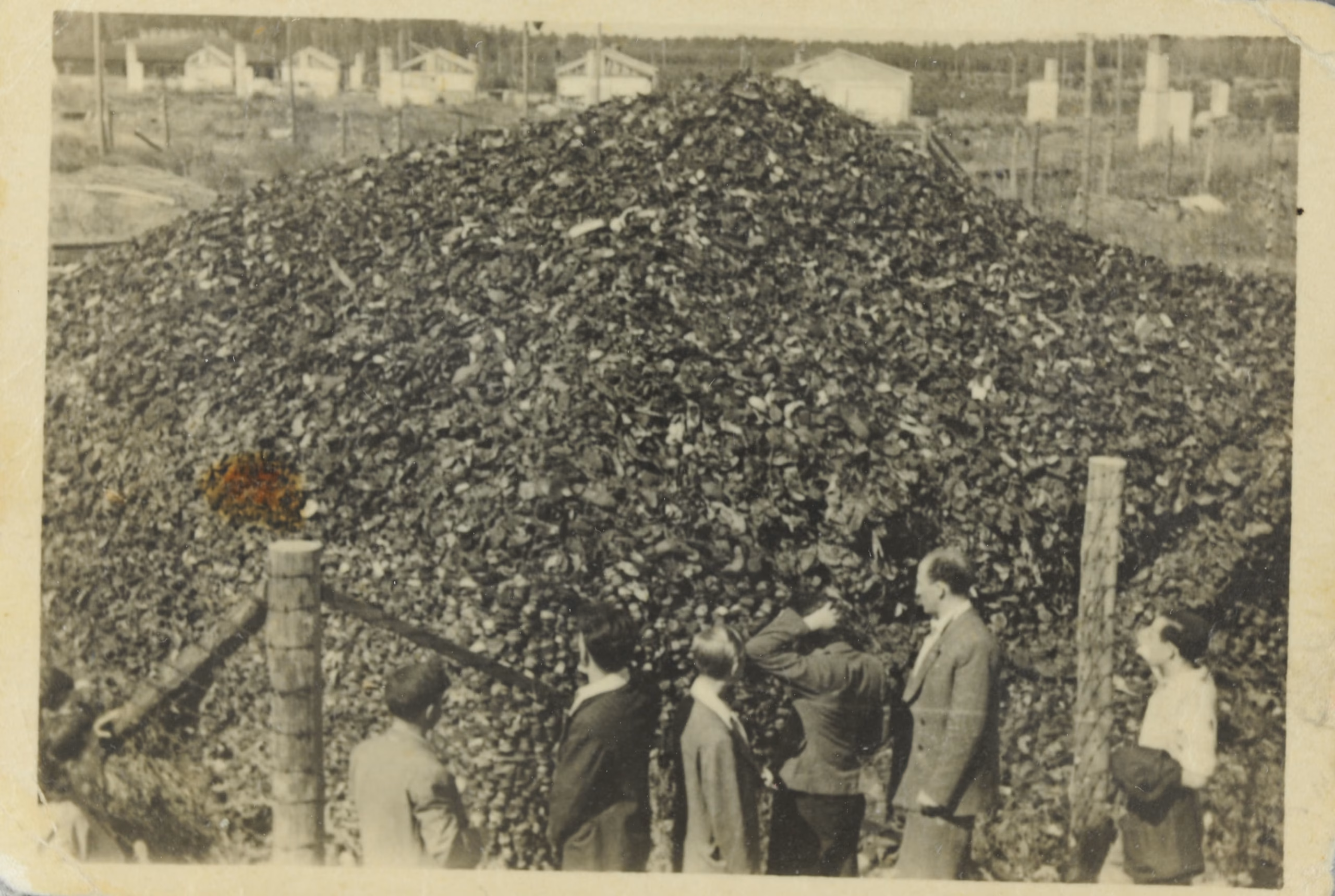
The Holocaust was the systematic, state-sponsored persecution and murder of six million European Jews by the Nazi German regime between 1933 and 1945. This was not incidental violence or wartime chaos. It was industrial. It was planned. It was documented in meticulous Nazi bureaucratic records. By the end of the Second World War, approximately two-thirds of European Jewry, nine million people in 1933, had been reduced to three million survivors by 1945, and had been murdered. Among them, 1.5 million were children.
“The Holocaust was not a war. War is fought between armies. The Jews had no army. The Holocaust was a one-sided massacre of a defenceless civilian population.” — Rabbi Jonathan Sacks z”l
The Nazis also murdered millions of others: over 250,000 Roma and Sinti in the genocide known as the Porajmos; more than three million Soviet prisoners of war; nearly two million non-Jewish Poles; over 250,000 people with disabilities (murdered in the so-called Action T4 programme); thousands of Jehovah’s Witnesses and gay men. The Holocaust’s epicentre was the destruction of the Jewish people, but its evil reached far beyond.
A Timeline of the Holocaust
The Holocaust did not happen overnight. It unfolded over twelve years, step by careful, legislated step.
- In January 1933, Adolf Hitler was appointed Chancellor of Germany. Anti-Jewish legislation begins within weeks.
- 1935 The Nuremberg Laws strip Jews of German citizenship, forbid marriage with non-Jews, and remove political rights. Jews are defined by race, not religion.
- November 1938, Kristallnacht, the Night of Broken Glass. Over 7,500 Jewish businesses were destroyed, 267 synagogues were burned, and approximately 30,000 Jewish men were sent to concentration camps in a single night.
- In September 1939, Germany invaded Poland. Jews are forced into sealed, overcrowded ghettos. The largest, in Warsaw, would eventually hold nearly 500,000 people.
- In June 1941, Germany invaded the Soviet Union. Mobile killing units (Einsatzgruppen) follow the army, shooting Jews en masse — 33,771 are murdered at Babi Yar, near Kyiv, in two days.
- January 1942: The Wannsee Conference. Senior Nazi officials coordinate the “Final Solution” — the systematic murder of every Jew in Europe. Six extermination camps are established in occupied Poland.
- 1942–1945 Jews from across occupied Europe are deported by rail to Auschwitz-Birkenau, Treblinka, Sobibor, Belzec, Chelmno, and Majdanek. Auschwitz-Birkenau alone killed an estimated 1.1 million people.
- April–May 1943 The Warsaw Ghetto Uprising. Jewish fighters hold out against German forces for nearly a month. It becomes the most powerful symbol of Jewish resistance.
- January–May 1945 Allied forces liberate the camps. Soviet troops liberated Auschwitz on 27 January. The world sees for the first time what has been done.
What is Yom HaShoah?
Yom HaShoah’s full Hebrew name is Yom HaZikaron laShoah ve-laG’vurah — Holocaust and Heroism Remembrance Day. The dual name is deliberate. It is not only a day of mourning for victims. It is also a day of honour for those who resisted: the fighters of the Warsaw Ghetto and the other uprisings, the partisans in the forests, and those who maintained their humanity, their culture, and their faith in impossible circumstances.
QUICK FACTS: YOM HASHOAH 2026
- Date (Hebrew): 27 Nisan 5786
- Date (Gregorian): Evening of 13 April to evening of 14 April 2026
- 2026 theme (Yad Vashem): “The Jewish Family”
- Established: First observed in 1951; enshrined in Israeli law by the Knesset, 1959
- Different from: International Holocaust Remembrance Day (27 January, UN)
The date was not chosen arbitrarily. The 27th of Nisan sits in proximity to 19 April 1943, the night German forces entered the Warsaw Ghetto to deport its last inhabitants, and the night the ghetto fought back. The date falls after Passover, which commemorates the Exodus from Jewish freedom in Egypt. The juxtaposition is not accidental. It asks us to hold both in our hands at once: liberation and catastrophe, exodus and extermination, freedom and its violent denial.
How is Yom HaShoah Observed?
IN ISRAEL
Yom HaShoah opens at sundown with a state ceremony at Yad Vashem in Jerusalem, the World Holocaust Remembrance Centre. The national flag is lowered to half-mast. Six Holocaust survivors light six torches, one for each million murdered. The President and Prime Minister speak. The Chief Rabbis recite prayers.
At 10:00 AM, the air raid sirens sound across the entire country. Everything stops. It is one of the most remarkable public rituals I have ever read about: millions of people, in cars, in shops, on motorways, standing still. Two minutes of collective silence, shared simultaneously across a nation.
Israeli television and radio broadcast Holocaust documentaries. Entertainment venues close. Schools hold special memorial sessions.
AROUND THE WORLD
Jewish communities around the world hold synagogue services, educational programmes, candlelighting ceremonies, and vigils. In the United States, the Holocaust Memorial Museum in Washington DC hosts a national observance during the broader “Days of Remembrance”, a week-long commemoration. Many schools, universities, and civic institutions also participate.
Yom HaShoah in Masorti Judaism
For those of us in the Masorti (Conservative) tradition and particularly for those at New London Synagogue, there is a rich body of liturgical material developed specifically for this day.
In 1981, the Federation of Jewish Men’s Clubs (FJMC), a branch of the Conservative/Masorti movement, created what has become one of the most widely practised Yom HaShoah rituals outside Israel: the Yahrzeit candle project. Each year, approximately 200,000 candles are distributed to Jewish communities around the world, together with accompanying prayers and meditations. The act is simple and profound: you light a candle, say a prayer, and in doing so, you join a chain of remembrance stretching from your living room to communities on every continent.
In 1984, Conservative Rabbi David Golinkin wrote a landmark article in the Conservative Judaism journal proposing a formal programme of Yom HaShoah observance, including fasting. Though fasting has not been universally adopted, the article shaped how the movement thinks about communal mourning on this day.
Perhaps most significantly, the Masorti movement in Israel, in partnership with Conservative leaders in North America, created Megillat HaShoah, a scroll and liturgical reading for Yom HaShoah. It is modelled on the five Megillot (scrolls) read on other Jewish festivals: just as we read Lamentations on Tisha B’Av, we can now read Megillat HaShoah on Yom HaShoah. It gives the day its own liturgical voice within the halachic tradition.
“Memory is the key. Not memory as nostalgia, not memory as mere information, but memory as the great Jewish act of imaginative identification making the past present.” — Rabbi Jonathan Sacks z”l
What This Means for a Convert
When you choose to become Jewish, you are not merely adopting a set of practices. You are joining a people, with all that entails. Their joys become your joys: the laughter of Purim, the light of Hanukkah, the freedom of Passover. And their grief becomes your grief.
Judaism has a remarkable concept at its heart: the idea that all Jews who will ever exist were present at Sinai. The convert who stands before the mikveh is not arriving from outside; they are returning to a place they were always meant to be. Part of that return is accepting the people’s memory: not as a foreign burden, but as your own.
Rabbi Sacks z”l used to say that Jewish memory is not passive recollection, it is active re-enactment. To say avadim hayinu “we were slaves” at the Passover Seder is to make the past present. Yom HaShoah asks something similar. It asks each Jew born or by choice to say: ” This happened to my people. The murdered were my family. The survivors were my ancestors. I carry their memory forward.
Sitting in shul this week, listening to the names being read aloud, one name after another, person after person, a litany of humanity reduced to a list, I felt something shift. This is why memory matters. Not so that we remain frozen in grief, but so that the names are not forgotten. So that each person who was murdered retains, at least in some measure, the dignity of being named, of being remembered, of mattering.
If you are also on a conversion journey, I encourage you to find out what your synagogue does for Yom HaShoah. Light a candle. Read Megillat HaShoah. Stand still, if you can, for two minutes at 10 AM. Let the silence be yours too.
Sources
Yad Vashem — World Holocaust Remembrance Center
Introduction to the Holocaust — USHMM Holocaust Encyclopedia
Yom HaShoah — My Jewish Learning
Yom HaShoah in Conservative Judaism — Exploring Judaism
Yom HaShoah — Jewish Virtual Library
Yom HaShoah 2026 — The Media Line
Yom HaShoah 2026 Statement — Raoul Wallenberg Centre
Leave a Reply